
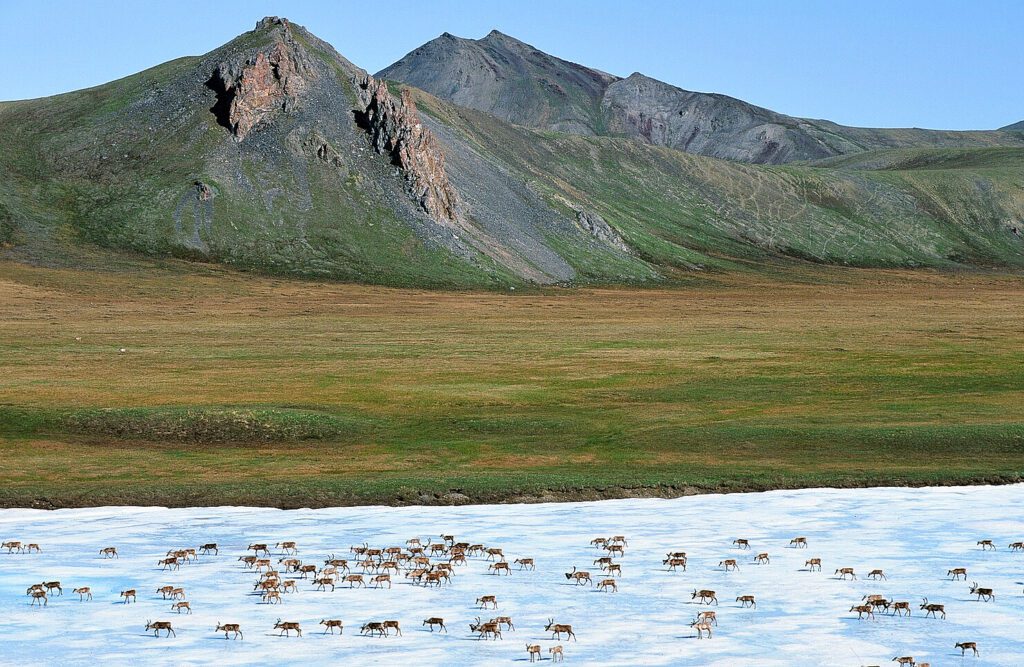
The Arctic National Wildlife Refuge in northeast Alaska is one of the world’s last intact wilderness ecosystems. Its Coastal Plain supports roughly 250 wildlife species, and serves as critical calving habitat for the Porcupine caribou herd, which migrates over 1,000 miles annually. The region holds deep cultural significance for the Gwich’in Nation. Protecting it matters for climate reasons (its ecosystems store significant carbon), for caribou and polar bear habitat (vulnerable to seismic exploration and roads), and for Alaska’s tourism economy, which generated $3.9 billion and 48,000 jobs in 2024.
Since Trump has taken office, the Refuge faces renewed pressure from oil and gas development. In June 2026, the Trump administration tried for the third time to sell off drilling rights in the sacred Arctic National Wildlife Refuge and for the third time in five years, the oil industry didn’t show up. To date, only a small fraction of promised revenues have been realized and only two bidders, without North Slope experience, hold leases. However, one of those entities – the Alaska Industrial Development and Export Authority – is the state’s own investment arm and has allocated $175 million for potential seismic exploration on the Coastal Plain. If permits are granted, potentially as soon as winter 2026-27, and seismic exploration moves forward, this could mean bulldozers driving over fragile tundra, destroying the local ecosystem while looking for oil.
AWL and its partners plan to fight any efforts to conduct seismic on the Refuge’s fragile coastal plain while fighting for future protections by engaging key decision-makers over the next few years through litigation, corporate accountability, congressional advocacy, and grassroots organizing. A new regional organizing program aims to generate over 1.5 million public actions in favor of Arctic protection. Long-term, the effort will prepare policy recommendations for a future administration, while deepening partnerships with the Gwich’in Nation and others to broaden the coalition advocating for the Refuge’s protection.