
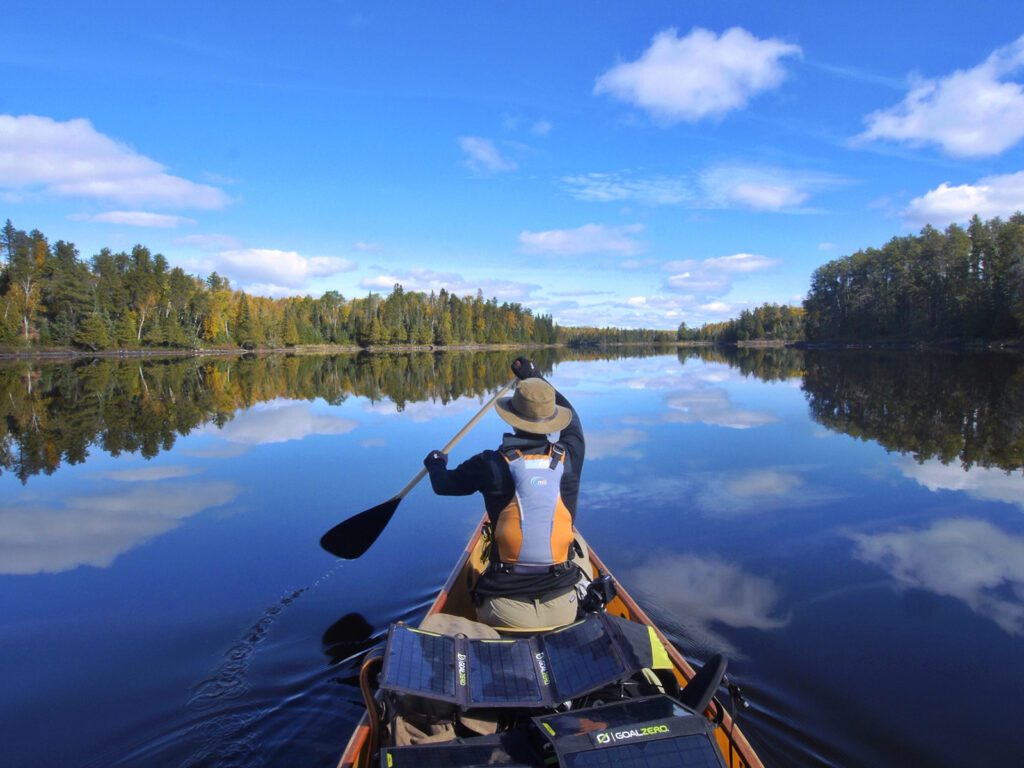
The Boundary Waters Canoe Area Wilderness forms part of a four-million-acre expanse of intact boreal forest and freshwater ecosystems alongside Voyageurs National Park, Quetico Provincial Park in Canada, and Superior National Forest. The Boundary Waters draws up to 150,000 wilderness-entry-permit visitors annually, making it the most visited wilderness in the country. The Superior National Forest holds 20% of all freshwater in the National Forest System. Three federally threatened species — the Canada lynx, long-eared bat, and gray wolf — call it home. The area lies within the 1854 Treaty Area, where the Anishinaabe (Ojibwe/Chippewa) retain sovereign rights to hunt, fish, and gather — rights they actively exercise and defend.
Ecologically, the Boundary Waters is ranked the sixth most critical region in the lower 48 states for climate resiliency. Its bogs, wetlands, and peatlands serve as natural carbon sinks, and its unbroken habitat enables wildlife and plant species to adapt and migrate across a vast connected landscape. The Boundary Waters is also the cornerstone of Minnesota’s $13.9 billion outdoor recreation economy. Communities like Ely, Grand Marais, and Duluth depend on the wilderness for tourism, small businesses, real estate, and quality of life. By contrast, sulfide-ore copper mining in the watershed could eliminate more than 22,500 jobs, cost $402 million to $1.6 billion in lost wages annually, reduce tourism revenue by $288 million per year, and drop regional property values.
In April 2026, Congress repealed the federal mineral withdrawal through the CRA, opening the door for mining interests to aggressively pursue reinstatement of Twin Metals’ federal mineral leases and accelerated permitting. In response, Save the Boundary Waters is executing a five-part strategy: preventing mining projects from advancing through legal action and scientific advocacy; building bipartisan federal support for permanent protections; mobilizing a national grassroots conservation movement; strengthening state-level protections; and advancing independent water quality research. This coalition-driven effort spans Tribal nations, outdoor businesses, youth leaders, hunters, anglers, and underserved communities.